The complete detergent science guide

Everything inside your detergent bottle - actually explained

You've seen the carousel. Now let's go deeper. This is a full breakdown of every ingredient category in laundry detergent - what each one does, why it's there, and why some of them are non-negotiable if you're washing cloth nappies.

6enzyme classes in modern detergent
2non-negotiables for cloth nappies
~12ingredient categories in a typical formula
70–80%of liquid detergent is just water
Start here

The two non-negotiables for cloth nappies

Everything else in your detergent is supporting cast. These two are the main event. Without them, your nappies are not getting genuinely clean - no matter how much you use or how hot you wash.

Non-negotiable #1

Surfactants

The physical lifters. They grab soil off your fabric and carry it away in the rinse water. Without surfactants, water can't penetrate fabric fibres - it just beads on the surface. Every drop of soil stays put.

For cloth nappies, you need a high-concentration surfactant system - not the diluted version found in budget formulas. Nappy soil is complex: urine proteins, fecal matter, skin oils, nappy cream residue. All at once. You need surfactants that can tackle all of it.

Look for: SLS, SLES, LAS, APG near the top of the ingredients list. If surfactants appear halfway down, concentration is too low.
Non-negotiable #2

Enzymes

The biological digesters. While surfactants physically lift soil, enzymes chemically dismantle it - breaking large insoluble stain molecules into tiny water-soluble fragments that rinse away completely.

Without enzymes, surfactants move organic matter around without fully removing it. Residual proteins and fats left in the fabric are what bacteria feed on - producing ammonia as a byproduct. That's the smell. Enzymes eliminate the food source. No residue, no smell.

Look for: protease, lipase, amylase, cellulase, mannanase, pectate lyase individually named on the label.

The ammonia smell - what's actually happening

This is the most misunderstood problem in cloth nappy washing. The ammonia smell isn't an ammonia problem. It's a urea problem.

Baby wees
fresh urine - barely any smell
Urea left in fabric
incomplete washing
Bacteria feed on it
producing urease enzyme
Ammonia produced
the smell you notice
Repeats every wash
cycle continues

The fix is protease - the enzyme that breaks down urea and urine proteins completely, leaving nothing for bacteria to feed on. More detergent won't fix it. Hotter water alone won't fix it. You need a detergent with a strong protease enzyme. Remove the urea, break the cycle.

Chapter 01

Surfactants: the physics of getting clean

Before anything else - before enzymes, before temperature - surfactants are why detergent works at all. Here is what they actually do, step by step.

The problem with water and grease is simple: they hate each other. Water molecules cling together in tight clusters, creating surface tension - that invisible skin that makes water bead on surfaces. Grease and oils are non-polar, meaning they don't interact with water molecules at all. Put them together and nothing happens.

Surfactants solve this with a split personality. Every surfactant molecule has two ends that behave completely differently. The hydrophilic head is attracted to water. The hydrophobic tail is repelled by water and attracted to oils and grease. Drop a surfactant into water and these molecules rush to every interface - tails pointing toward any greasy surface, heads staying in the water.

When enough surfactant molecules surround a soil particle, they form a micelle - a spherical structure with the dirt trapped inside, surrounded by outward-facing hydrophilic heads that keep the whole package suspended in the wash water. That micelle-enclosed dirt then rinses away with the water.

Why nappies need high-concentration surfactants: Research confirms that the optimum pH range for surfactant cleaning is 9–10.5. At this pH, soil and fibres become more negatively charged and repel each other - physically helping the surfactant separate them. Budget detergents with low surfactant concentrations simply don't have enough molecules to form adequate micelles around heavy nappy soil loads.

What you'll see on the label

SLS (sodium lauryl sulphate)Powerful anionic surfactant. Strong at soil removal.
SLES (sodium laureth sulphate)Milder version of SLS. Common in liquid detergents.
LAS (linear alkylbenzene sulphonate)The world's most widely used anionic surfactant. Excellent at lifting soil.
APG (alkyl polyglucoside)Plant-derived non-ionic surfactant. Coconut-based. Biodegradable and gentle.
Cocamidopropyl betaineAmphoteric (works in both acidic and alkaline conditions). Often used with anionic surfactants for boosted performance.

Micelle formation - watch it happen

Tap play to see how surfactants lift soil off fabric

wash water fabric fibre soil

Anionic vs. non-ionic - what's the difference?

Anionic (charged)
Negatively charged. Excellent at grabbing and lifting general soil and protein deposits. Main workhorse in most formulas.
Non-ionic (uncharged)
No charge. Highly effective at cutting through oily deposits. Works well at lower temperatures. Boosts anionic performance.

Premium detergents use both types together. The combination outperforms either type used alone - anionic handles the soil, non-ionic handles the grease.

Chapter 02

All 6 enzyme classes - the complete explorer

There are six distinct enzyme classes used in laundry detergents - not three, not two. Each targets a completely different stain category. Tap each tab to explore.

Tip: the more enzyme types your detergent declares on the label, the broader its stain coverage. A detergent that only lists "enzymes" without naming types is being deliberately vague.

Protease
the protein eater - the most critical enzyme for cloth nappies

Protease cuts the peptide bonds that hold protein chains together. A protein stain - like the ones covering your nappies - is one enormous molecule. Protease breaks it into dozens of tiny amino acids that dissolve in water and rinse away completely.

This is the enzyme doing the work on urine. Fresh urine contains urea - a nitrogen-rich compound that is nearly odourless. But urea left in fabric after an incomplete wash becomes food for bacteria. Those bacteria produce their own urease enzyme, which converts urea into ammonia. That's the smell. Protease removes the urea source completely - breaking the ammonia cycle at the root.

What it targets
poo & fecal matterurine & ureabloodsweategg & dairygrassformula & breast milk
On the label look for: Protease, Savinase® (Novozymes), Alcalase® (Novozymes), Everlase®, Subtilisin
🧺Critical for nappies. Without protease, urine proteins and fecal matter are not fully removed - leading to ammonia smell at every nappy change. This is the enzyme to prioritise above all others.
💩
Fecal matter
Protease cuts the protein chains in fecal bacteria and undigested food protein into small amino acids. Fully water-soluble. Rinses completely.
🤍
Urine & urea
Breaks down the urea and urinary proteins - eliminating the substrate bacteria use to produce ammonia. Stops the smell at the source.
🩸
Blood
Haemoglobin is a protein. Protease cleaves it entirely. Cold water preferred - hot water "cooks" blood proteins, setting them permanently.
🥛
Breast milk & formula
Casein (milk protein) broken down into peptides and amino acids. Eliminates odour-causing residue that builds up in liners and inserts.
Lipase
the fat eater - the key to preventing nappy repelling

Lipase catalyses the hydrolysis of triglycerides - the chemical structure that fats and oils are built from - converting them into fatty acids and glycerol, both of which dissolve in water and rinse out completely.

Nappy cream and skin sebum (the natural oil your skin produces) are fat-based deposits that accumulate in nappy fibres with every wash if lipase isn't present. This buildup creates a hydrophobic (water-repelling) coating on the absorbent core. This is what causes "repelling" - where the nappy surface beads liquid rather than absorbing it. Lipase deficiency is one of the most common causes.

What it targets
nappy cream residueskin sebumbody oilscooking greasebutter & fatolive oil
On the label look for: Lipase, Lipolase® (Novozymes), Lipex® (Novozymes)
🧺Critical for long-term nappy performance. Without lipase, nappy cream and skin oils accumulate wash after wash - eventually causing repelling. A detergent without lipase is slowly degrading your nappies' absorbency over time.
🧴
Nappy cream
Zinc oxide cream is triglyceride-based. Lipase cleaves the triglyceride bonds - preventing the waxy coating that causes repelling.
🫧
Skin sebum (body oil)
Every baby has natural skin oils that transfer to fabric. Lipase converts these from hydrophobic fats to water-soluble fatty acids.
🧈
General fat & grease
Fat broken into glycerol and fatty acids - both water-soluble at the alkaline pH of most detergent wash water.
Amylase
the starch eater - stops ghosting

Starch is made of long glucose chains linked by glycosidic bonds. Amylase snips these bonds - converting large insoluble starch molecules into small water-soluble sugars (maltose and glucose) that rinse away.

Starch stains are notorious for "ghosting" - they look clean when wet but reappear as fabric dries. This happens because surfactants can move starch particles without breaking them down. Amylase fully digests the starch so there's nothing left to reappear.

What it targets
puréed food & baby foodporridge & cerealpasta & potatoricechocolategravy & sauces
On the label look for: Amylase, Termamyl® (Novozymes), Stainzyme® (Novozymes), Duramyl®
🧺Useful for nappies, essential for the rest of baby's laundry. Less critical than protease and lipase for nappies specifically, but becomes the key enzyme once solids start and food stains become part of the daily wash load.
🥣
Porridge & cereal stains
Starch chains broken into sugars. No ghosting on re-drying. Fabric returns to original colour.
🍫
Chocolate
Chocolate stains have both a starch and fat component. Amylase handles the starch matrix - works alongside lipase for the fat.
🫙
Baby food purée
Purée starch fully broken down - prevents the residue-on-fabric-on-drying effect that comes with surfactant-only washing.
Cellulase
the fabric refresher - works differently to all the others

Cellulase doesn't attack stains directly. Instead, it gently breaks down the tips of damaged cotton fibres - called microfibrils - that protrude from the fabric surface after washing. These tiny fibre tips trap soil particles and create the grey, dull look in older cotton fabrics.

By selectively removing these protruding microfibrils, cellulase releases the trapped dirt and restores the fabric surface. The result is brighter colour, reduced pilling, softer feel - and importantly, better absorbency in cotton nappy fabrics over the long term. Ariel and OMO's premium variants highlight cellulase for colour care and anti-pilling.

What it targets
particulate soil trapped in fibresfabric greyingpilling & fuzzcolour dullness
On the label look for: Cellulase, Carezyme® (Novozymes), Celluclean® (Novozymes)
🧺Excellent for cotton nappy longevity. Most cloth nappy inserts are cotton or cotton-blend. Cellulase helps maintain fibre integrity and absorbency over hundreds of washes - making it a valuable long-term ingredient.
🧵
Damaged cotton microfibrils
Protruding tips are selectively cleaved - releasing trapped soil and smoothing the fabric surface. Intact crystalline fibres are unaffected.
Fabric greying
Grey discolouration in white cotton is largely caused by soil trapped in damaged microfibrils. Cellulase removes the trap - fabric brightens.
Colour fading
By removing the fuzzy surface layer of worn fibres, colours appear more vibrant. Fabric looks newer after washing than before.
Mannanase
the gum buster - the one hiding in your food and skincare

Mannanase targets galactomannan, a gum-based polysaccharide used as a thickener in hundreds of processed foods and personal care products. Guar gum and locust bean gum are both mannans. They bond to fabric fibres in a way that surfactants cannot easily break, creating sticky, persistent stains.

OMO's ingredient list declares mannanase alongside protease and amylase, making it one of the more transparent enzyme declarations available in Australian supermarkets. Particularly relevant once babies start solids, and for anyone using mannan-containing skin creams, sunscreens or nappy balms.

What it targets
ice cream & frozen dessertschocolate & fudgetoothpastebody lotion & sunscreenketchup & saucessalad dressing & mayo
On the label look for: Mannanase, Mannaway® (Novozymes)
🧺Relevant for nappy balms and skincare. Many popular nappy creams and balms contain guar gum or similar mannan-based thickeners. Without mannanase, this residue builds up in nappy fabric over time.
🍦
Ice cream & frozen desserts
Guar gum bonds firmly to fabric - surfactants can't break the bond. Mannanase dissolves it enzymatically into soluble sugars.
🧴
Nappy balm & lotion
Many baby skincare products use gum-based thickeners. Mannanase prevents these from accumulating on nappy fibres.
🌿
Tomato sauce & ketchup
Mannan-containing thickeners in sauces converted to soluble sugars that rinse away cleanly with the wash water.
Pectate Lyase
the fruit stain fighter - the newest addition to commercial detergents

Pectin is the natural structural compound in cell walls of all fruit and vegetables - it's what makes jam set and gives fruit its texture. It's also what makes fruit juice and berry stains among the hardest stains to fully remove. Pectin bonds tightly to fabric in a way surfactants struggle with.

Pectate lyase (sometimes called pectinase) entered commercial detergents in the early 2000s, developed by Novozymes. It degrades pectin chains into small water-soluble fragments. For families washing clothes and bibs covered in purée, berry stains and fruit juice, this enzyme is doing significant work.

What it targets
berry & fruit stainsfruit juicebaby food puréewinetomato-based stainsjam & marmalade
On the label look for: Pectate lyase, Pectinase, Xpect® (Novozymes)
🧺Less critical for nappies, important for baby's wider laundry. Berry, fruit and purée stains on bibs, clothing and muslin cloths - pectate lyase is the enzyme solving these. Not commonly found in budget detergents.
🍓
Berry stains
Pectin in berry cell walls broken down - colour compounds and stain molecules become soluble and rinse completely.
🍅
Tomato & fruit purée
Pectin matrix dismantled. Works alongside amylase for the starch component - together achieving complete stain removal.
🍷
Wine & grape juice
Grape pectin broken into soluble fragments - eliminating the persistent tannin-pectin complex that makes wine stains set.
Chapter 03

Powder vs. liquid - what's actually different

The surfactants and enzymes do the same job in both formats. But the supporting ingredients - and how they're formulated - differ meaningfully.

Powder detergent

Higher concentration of active ingredients per gram. No preservatives needed - dry format doesn't support microbial growth.

  • Typically contains sodium carbonate (washing soda) as the primary builder - highly effective at softening hard water
  • Sodium sulphate used as a filler to aid powder flow and even distribution - contributes nothing to cleaning
  • Oxygen bleach (sodium percarbonate) often included - activates at 40°C+, good for sanitisation
  • No preservatives required in dry format - enzymes are more stable in powder form long-term
  • Generally better value per wash - you're not paying for water
  • Can leave residue if machine runs cool or detergent doesn't dissolve fully - use a prewash cycle or dissolve first

Liquid detergent

More convenient for pre-treating stains. Contains water as the primary carrier - typically 70–80% of the bottle.

  • Requires preservatives (MI, phenoxyethanol) to prevent microbial growth - not needed in powder
  • Enzyme stabilisers (calcium chloride, sodium formate, borax) essential - prevent enzymes degrading in liquid storage
  • Sodium citrate commonly used as builder - biodegradable and effective, but milder than washing soda
  • Propylene glycol and sodium chloride used for viscosity - purely textural, no cleaning function
  • Easier to measure accurately - better for front loaders requiring low-suds formulas
  • Effective for pre-treating stains directly - apply to stain before washing for best results

For cloth nappies: both formats can work excellently. Powder detergents with washing soda tend to perform better in hard water areas. Liquid detergents are easier to dose accurately in front loaders. The most important variable in either format is the enzyme and surfactant profile - not whether it's powder or liquid.

Chapter 04

The complete ingredient index

Every ingredient category you'll encounter on a detergent label - what it does, why it's there, and what it means for nappies. Filter by category or tap any card to expand.

Ingredients are listed in descending order of concentration on Australian labels. The first few ingredients are what's doing the heavy lifting.

Surfactants
SLS, SLES, LAS, APG, cocamidopropyl betaine
+
powderliquid
non-negotiable

The primary cleaning agents. Molecules with a water-loving head and grease-loving tail that physically lift soil off fabric and suspend it in wash water. Without surfactants, detergent cannot clean.

Anionic surfactants (SLS, SLES, LAS) carry a negative charge and excel at soil removal. Non-ionic surfactants (APG, alcohol ethoxylates) are uncharged and particularly effective against oily deposits. Premium detergents use both types together.

🧺 For nappies: look for surfactants listed in the top 3–4 ingredients. Low-concentration formulas cannot handle the complex soil load of nappy washing.
Enzymes
Protease, lipase, amylase, cellulase, mannanase, pectate lyase
+
powderliquid
non-negotiable

Biological catalysts that chemically dismantle stain molecules at the molecular level. Each enzyme type targets a specific stain category - protease for protein, lipase for fat, amylase for starch, cellulase for fabric care, mannanase for gums, pectate lyase for pectin.

Enzymes don't get consumed - they reset and repeat the process thousands of times per wash. A detergent with more named enzyme types covers more stain categories. "Enzyme blend" without naming types is a vague claim.

🧺 For nappies: protease and lipase are the most critical. Protease removes urine proteins and stops the ammonia cycle. Lipase removes fat-based deposits that cause repelling.
Sodium carbonate
washing soda, soda ash
+
mainly powder

A naturally occurring mineral (mined as trona ore) that acts as a builder, pH adjuster and water softener simultaneously. It traps calcium and magnesium ions in hard water so they can't interfere with surfactant performance - and raises pH to the optimal cleaning range of 9–10.5.

🧺 For nappies: particularly valuable in hard water areas. Adding a small amount of washing soda to your wash can meaningfully improve results if you're struggling with persistent odour or poor cleaning.
Sodium citrate / citric acid
lemon-derived builder and pH adjuster
+
powderliquid

Citric acid (the compound in lemon juice) and its salt, sodium citrate, are chelating agents that bind to hard water mineral ions and prevent them from interfering with surfactants. Also adjusts pH and helps prevent mineral scale buildup on your machine. Fully biodegradable and skin-friendly - increasingly common in eco-formulations as an alternative to EDTA.

🧺 For nappies: a positive sign on the label. Biodegradable, effective at softening water for surfactants, and helps remove mineral odours.
Tetrasodium EDTA
chelating agent
+
mainly liquid

EDTA (ethylenediaminetetraacetic acid) is a highly effective chelator - it binds to calcium, iron, copper and magnesium ions in hard water and holds them in solution, preventing them from deactivating surfactants or forming deposits on fabric. Very effective but not readily biodegradable - sodium gluconate is the more eco-friendly alternative increasingly used in modern formulas.

🧺 For nappies: functional ingredient. Not concerning, but if eco-credentials matter, look for sodium gluconate instead.
Sodium hydroxide
caustic soda, NaOH
+
powderliquid

Used in tiny amounts to adjust pH to the optimal cleaning range. Despite its reputation as a caustic compound, the concentrations used in laundry detergent are very low - and at those levels, it fully dilutes and rinses out during the wash. Essential for getting the pH right for both surfactant performance and enzyme stability.

🧺 For nappies: a functional and necessary pH-adjusting ingredient. Nothing to be concerned about at detergent concentrations.
Sodium bicarbonate
baking soda, NaHCO₃
+
powderliquid

A mild alkali that balances pH and helps neutralise acidic odours - including those produced by urine. Arm & Hammer use it as a core ingredient alongside enzymes, marketing it specifically for its odour-neutralising properties. Food-grade, gentle, and effective.

🧺 For nappies: genuinely useful. Its alkalinity helps neutralise the acidic compounds in urine, and it boosts surfactant performance in the 9–10.5 pH zone where cleaning efficiency is highest.
Calcium chloride
enzyme stabiliser
+
liquid only

Enzymes are proteins - and in liquid form, they are susceptible to degradation over time. Calcium chloride stabilises the three-dimensional structure of enzymes in the bottle, preventing them from unfolding and becoming inactive before you use the product. Present in tiny amounts, it serves no cleaning function - purely a shelf-life ingredient.

🧺 For nappies: a positive sign in liquid detergents. Indicates the formula has properly stabilised its enzyme system for shelf life.
Sodium formate
enzyme stabiliser
+
liquid only

Another enzyme stabiliser in liquid detergents - works alongside calcium chloride to protect enzyme structure during storage. Keeps protease, lipase and amylase active and ready to work from the moment the detergent hits your wash water. Contributes nothing to cleaning.

🧺 For nappies: a sign of a well-formulated liquid detergent that has invested in properly protecting its enzyme system.
Borax pentahydrate
sodium tetraborate decahydrate
+
powderliquid

In liquid detergents, borax stabilises enzymes and prevents their degradation in storage. In powder detergents, it also adjusts pH and softens water, allowing surfactants to work more effectively. A multifunctional ingredient with a long history in laundry formulations.

🧺 For nappies: functional and useful. Not a concerning ingredient at laundry concentrations - fully dilutes and rinses out in the wash cycle.
Carboxymethylcellulose
CMC - anti-redeposition polymer
+
mainly liquid

A plant-derived polymer that coats loosened soil particles, keeping them suspended in wash water rather than allowing them to resettle on fabric. Also builds viscosity in liquid formulas - making the detergent thicker. The anti-redeposition function is genuinely useful; the thickening is cosmetic.

🧺 For nappies: a positive ingredient. Helps ensure that soil lifted off nappy fibres stays in the wash water and rinses away - rather than redistributing onto other nappies in the load.
PVP / polyvinylpyrrolidone
dye transfer inhibitor
+
mainly liquid

A water-soluble polymer that preferentially binds to loose dye molecules in the wash water - preventing them from migrating onto other items in the load. Particularly useful when washing coloured and white items together. Not relevant to cleaning performance, but protects fabric from colour bleeding.

🧺 For nappies: moderately useful. If you wash coloured and white nappies together, PVP prevents dye transfer between items.
Methylisothiazolinone
MI or MIT - preservative
+
liquid only

A broad-spectrum antimicrobial preservative that prevents microbial growth in liquid detergents. Without it, organic surfactants in liquid formulas would degrade and the product would become contaminated within weeks. Restricted in rinse-off cosmetics in the EU due to skin sensitisation potential at higher concentrations - in laundry detergent, the dilution during washing reduces contact levels significantly.

⚠ For nappies: if your baby has very sensitive skin or known MI sensitivity, look for MI-free formulas using phenoxyethanol or potassium sorbate as alternatives.
Phenoxyethanol
gentler preservative alternative
+
liquid only

A broad-spectrum preservative increasingly used as an alternative to MI/MIT in sensitive-skin formulations. Generally considered gentler than isothiazolinones. Common in eco-conscious and sensitive-skin liquid detergents.

🧺 For nappies: a positive sign if you're looking for an MI-free sensitive-skin formula with adequate preservation.
Sodium chloride
table salt - viscosity modifier
+
liquid only

Yes, your liquid detergent contains salt. It's used purely to adjust viscosity - making the liquid thicker and easier to pour and measure. Has absolutely zero cleaning function. Its presence on the label is occasionally misread as meaningful - it isn't.

🧺 For nappies: completely irrelevant. Neither helpful nor harmful.
Optical brighteners
FWA, fluorescent whitening agents, stilbene derivatives
+
powderliquid
⚠ avoid for nappies

Chemical compounds that absorb UV light and re-emit it as visible blue-white light - making fabric appear whiter and brighter. Zero cleaning function. They accumulate on fabric fibres over time as a chemical residue coating.

⚠ For nappies: avoid. The residue coating can reduce the breathability of PUL (the waterproof layer in nappy covers) and accumulates in absorbent fibres. Look for "no optical brighteners" or "brightener-free" on the label.
Fabric softeners / quats
quaternary ammonium compounds, cationic surfactants
+
powderliquid
⚠ avoid for nappies

Fabric softeners work by depositing positively charged molecules (quaternary ammonium compounds) onto fibre surfaces, reducing friction and creating softness. On the absorbent core of a cloth nappy - cotton, hemp or bamboo - this creates a hydrophobic coating that causes the nappy to repel liquid rather than absorb it.

⚠ For nappies: one of the most damaging ingredients possible. Even one or two washes with a softener-containing detergent can cause significant repelling requiring a full strip wash to reverse. Some 2-in-1 detergents contain softeners - always check.
Heavy fragrance
parfum, fragrance, synthetic fragrance
+
powderliquid
⚠ use cautiously

Fragrance molecules are large organic compounds that bind to fabric fibres and persist through washing. Strong fragrance in a detergent often masks incomplete cleaning - covering residual organic matter rather than removing it.

⚠ For nappies: genuinely clean nappies are odourless. If your washed nappies smell strongly of fragrance, that's residue. If they smell of nothing at all, they're clean. Fragrance-free formulas are almost always preferable for nappy washing.
Sodium sulphate
filler - powder detergents only
+
powder only

Used as a filler and flow agent in powder detergents - helps the powder flow freely, prevents clumping and ensures even distribution of active ingredients through the granule. Has no cleaning function whatsoever. Its presence is why some powders feel heavier or bulkier than their active ingredient concentration would warrant.

🧺 For nappies: completely neutral. Neither helpful nor harmful - simply a manufacturing necessity in powder format.
Dyes / colorants
CI numbers, colour additives
+
powderliquid

Added exclusively for consumer appeal - the blue in blue detergent, the green in "fresh" variants. Contribute nothing to cleaning. Rinse out without significant residue, so not harmful - just completely pointless from a cleaning perspective.

🧺 For nappies: irrelevant. If two detergents are otherwise identical, the coloured one offers nothing the clear one doesn't.
Quick reference

At a glance - what everything does

Ingredient Role For nappies
Surfactants (SLS, LAS, APG) Primary cleaning - lift and suspend soil Essential
Protease Breaks down protein stains, urea, fecal matter Critical - stops ammonia smell
Lipase Breaks down fats, oils, nappy cream Critical - prevents repelling
Amylase Breaks down starch stains Useful for food stains
Cellulase Fabric care, removes damaged microfibrils Good for cotton longevity
Mannanase Breaks down gum-based stains Good for nappy balm residue
Pectate lyase Breaks down fruit/pectin stains Useful for baby's laundry
Sodium carbonate Water softener, pH adjuster, builder Excellent - especially hard water
Sodium citrate / citric acid Chelator, biodegradable builder Good - eco-friendly option
Calcium chloride Enzyme stabiliser in liquid Good sign - protects enzymes
Sodium formate Enzyme stabiliser in liquid Good sign - protects enzymes
CMC (carboxymethylcellulose) Anti-redeposition, soil stays out Useful
Sodium chloride Thickener (viscosity) Neutral - it's just salt
Methylisothiazolinone (MI) Preservative Caution for sensitive skin
Dyes / colorants Appearance only Irrelevant
Optical brighteners (FWA) Makes fabric look whiter under UV Avoid - residue on PUL
Fabric softeners / quats Coats fibres for softness Never - destroys absorbency
Heavy fragrance Scent only - often masks odour Avoid - masks incomplete clean
🐑
Important exception

Wool items need a specialist wool wash

Everything on this page applies to your standard cloth nappies, inserts, wipes and everyday laundry. Wool is a completely different situation and must be treated separately.

Wool fibres are made of keratin, a protein. Protease enzymes - the same ones that eat poo stains and urine proteins - will also eat your wool. Even a single wash with a standard enzyme detergent can cause irreversible damage to wool fibres, causing matting, shrinkage and fibre breakdown that cannot be undone.

This includes all Wool covers and wool accessories. All wool items must be washed using a dedicated wool wash - a product that is specifically enzyme-free and pH-neutral, formulated to clean wool without damaging its protein structure.

Wool covers also typically require lanolising after washing to restore their natural water-resistant properties. A standard detergent wash will strip the lanolin completely.

Shop Wool Care
Recommended for cloth nappies

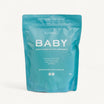
Baby Beehinds Baby Laundry Detergent

A plant-based powder detergent formulated specifically for cloth nappies and sensitive baby skin. Built around the four key enzymes covered in this guide - protease, lipase, amylase and mannanase - with no optical brighteners, no fabric softeners and no synthetic fragrance.

4 named enzymes: protease, lipase, amylase, mannanase
Plant-based surfactants
Sodium percarbonate for sanitisation and stain lifting
No optical brighteners, no fabric softeners
No synthetic fragrance - eucalyptus oil only
Suitable for sensitive and eczema-prone skin
Greywater and septic safe
Shop now - $22.95 AUD or subscribe and save 10%
Full ingredients list

Sodium carbonate, Sodium citrate, Sodium percarbonate, Sodium silicate, plant based surfactants, plant derived sequestrants, enzymes (lipase, protease, amylase, mannanase), eucalyptus oil

How each ingredient earns its place
Sodium carbonate - washing soda. Builder and pH adjuster.
Sodium citrate - biodegradable chelator. Softens hard water.
Sodium percarbonate - oxygen bleach. Sanitises and lifts stains at 40°C+.
Sodium silicate - builder and corrosion inhibitor.
Plant based surfactants - the primary soil lifters.
Plant derived sequestrants - chelators that trap hard water minerals.
Protease, lipase, amylase, mannanase - the four key stain-digesting enzymes.
Eucalyptus oil - natural fragrance with mild antibacterial properties.
Sources
  1. Novozymes. A Beginner's Guide to Enzymes in Detergents. biosolutions.novozymes.com, 2020.
  2. Wikipedia. Detergent Enzymes; Laundry Detergent. Citing published chemistry literature, 2026.
  3. Arm & Hammer. Glossary of Laundry Detergent Ingredients. armandhammer.com, 2024.
  4. Persil (Henkel/Unilever). Ingredients Guide: Enzymes. persil.com, 2024.
  5. Creative Enzymes. Top 5 Best Enzyme Detergents for Urine - mechanism guide. 2025.
  6. Environmental Science: Water Research & Technology. Characterization of urea hydrolysis in fresh human urine. RSC Publishing, 2018.
  7. Clorox Research Team. Washing Clothes in Cold Water vs Hot Water. clorox.com, 2023.
  8. Happi. Formulating Liquid Laundry Detergents - industry guide. happi.com, 2024.
  9. NanoTemper Technologies. Stability of Enzymes in Liquid Laundry Detergent. Application note, 2023.
  10. Infinita Biotech. A Complete Overview of Detergent Enzymes. infinitabiotech.com, 2025.